
Babe/Bertie Bean
Table of Contents
Primary sources
All newspaper clippings come from California, unless otherwise stated.

Transcription:
IN MAN'S ATTIRE TENANTS AN ARK
"Babe" Bean of Stock-ton Proves to Be a Woman.
---
Has For Weeks Inhabited a Small Craft on Mc-Leods Lake.
---
Substituted Male Garb for Skirts In Order to Obtain Work Readily.
---
STOCKTON, Cal., Aug 23. -- One of the strangest cases that have come under the eyes of the local police is that of a pretty, dark-haired girl who is mas-querading as a boy, and whose life his-tory would give the novelist a plot for one of the most readable books of the age. "Babe" Bean is the name she has gone by, but what her real name is she alone knows, and she is not likely to divulge is, as she claims to come from one of the best families in the land.
Born in the South, "Babe" Bean has the dark hair and full mouth that tell of love and music, adventure and pleasure. She is passionately fond of music and was on her way to church in boy's attire just to hear the music when Detectives Carroll and Klench told her that they would like to have some explanation of her strange freak, and took Miss Bean with them to see Chief of Police Gall. The girl in men's clothes came off best in her encounter with the officers, as she was posted on the law governing such cases.
To the officers Miss Bean said that she reached this city on July 17, and that she had lived ever since in an ark on the banks of McLeods Lake. She disclaimed any intention of violating any law, and said that she preferred to travel in male attire, as her chances for procuring work were made better.
All this she said on paper, for the girl-boy cannot talk. The police though that Miss Bean was shamming when she drew out her little notebook and answered with her pencil the question put to her. They found out, however, that she has not spoken to a soul since she has been in Stockton, and that she always makes her wants known be means of her pencil. This she uses with a rapidity that would be the envy of any shorthand reporter. What she says on paper, too, is always written in the best of English, and it is evident that Miss Bean has generally traveled in the better walks of life.
From The San Francisco Call newspaper, August 24th, 1897. Courtesy of the Digital Transgender Archive.
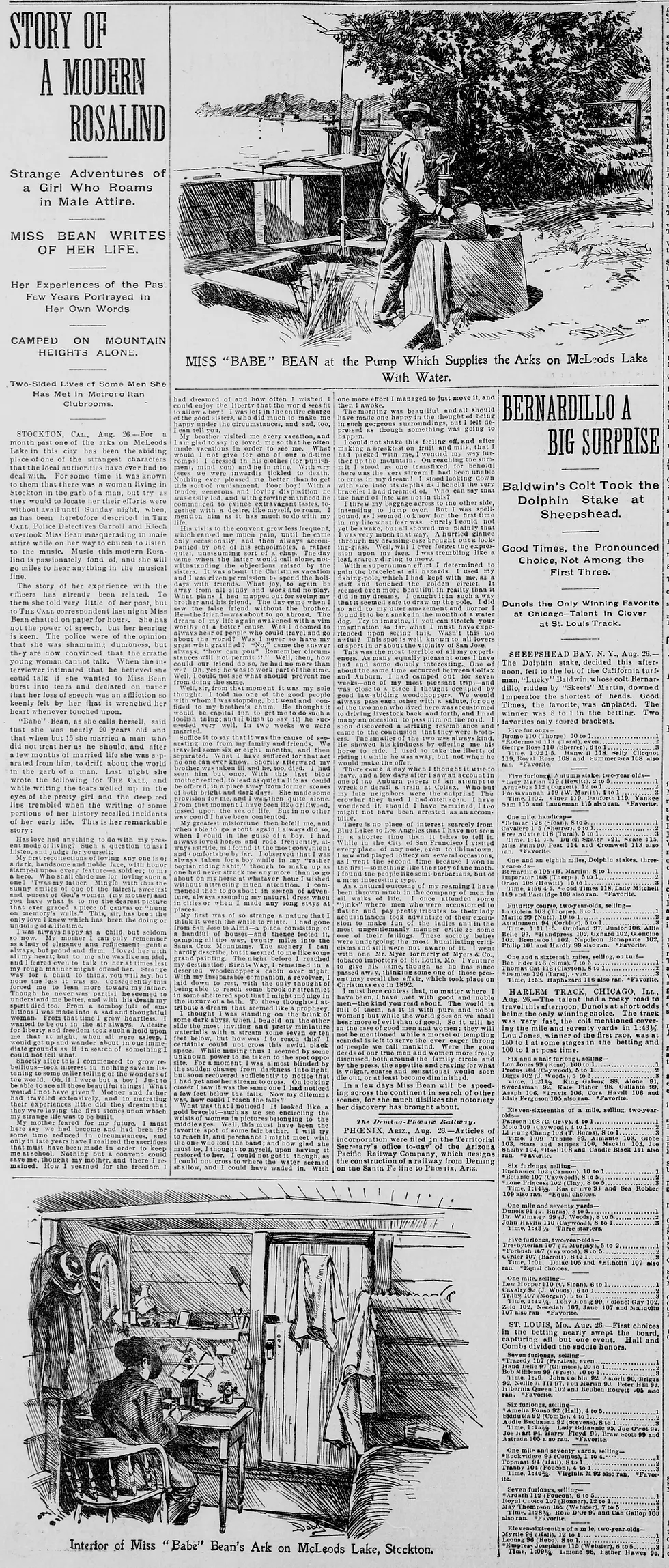
Transcription:
STORY OF A MODERN ROSALIND
Strange Adventures of a Girl Who Roams in Male Attire.
---
MISS BEAN WRITES OF HER LIFE
---
Her Experiences of the Pas[t] Few Years Portrayed in Her Own Words
---
CAMPED ON MOUNTAIN HEIGHTS ALONE
---
Two-Sided Lives of Some Men She Has Met in Metropolitan Clubrooms.
---
STOCKTON, Cal., Aug 26 -- For a month past one of the arks on McLeods Lake in this city has been the abiding place of one of the strangest characters that the local authorities have ever had to deal with. For some time it was known to them that there was a woman living in Stockton in the garb of a man, but try as they would to locate her their efforts were without avail until Sunday night, when, as has been heretofore described in THE CALL Police Detectives Carroll and Klech overtook Miss Ban masquerading in make attire while on her way to church to listen to the music. Music this modern Rosa-lind is passionately fond of, and she will go miles to hear anything in the musical line.
The story of her experience with the officers has already been related. To them she told very little of her past, but to THE CALL correspondent last night Miss Bean chatted on paper for hours. She has not the power of speech, but her hearing is keen. The police were of the opinion that she was shamming dumbness, but they are now convinced that the erratic young woman cannot talk. When the in-terviewer intimated that he believed she could talk if she wanted to Miss Bean burst into tears and declared on paper that her loss of speech was an affliction so keenly felt by her that it wrenched her heart whenever touched upon.
"Babe" Bean, as she calls herself, said that she was nearly 20 years old and that when but 15 she married a man who did not treat her as he should, and after a few months of married life she was sep-arated from him, to drift about the world in the garb of a man. Last night she wrote the following for THE CALL, and while writing the tears welled up in the eyes of the pretty girl and the deep red lips trembled when the writing of some portions of her history recalled incidents of her early life. This is her remarkable story:
Has love had anything to do with my pres-sent mode of living? Such a question to ask! Listen and judge for yourself:
My first recollections of loving anyone is of a dark, handsome and noble face, with honor stamped upon every feature--a soldier; to me a hero. Who call chide me for living such a one? 'Twas my father. Mingie with this the sunny smiles of one of the fairest, sweetest and purest of God's women (my mother) and you have what is to me the dearest picture that ever graced a piece of canvas or "hunh on memory's walls." This, sir, has been the only love I knew which has been the doing or undoing of a lifetime.
I was always a happy child, but seldom so now. My mother I can only remember as a lady of elegance and refinement--gentle always, but proud and firm. I loved her with all my heart; but to me she was like an idol, and I feared even to talk to her at times lest my rough manner might offend her. Strange way for a child to think, you will say, but none the less it was so. Consequently this forced me to lean more toward my father. Though whenever was partial he seemed to understand me better, and with his death my spirit died too. From a tomboy full of am-bitions I was made into a sad and thoughtful woman. From that time I grew heartless. I wanted to be out in the air always. A desire for liberty and freedom took such a hold upon me that at night, when we were all asleep, I would get up and wander about in our imme-diate grounds as if in search of something I could not tell what.
Shortly after this I commenced to grow re-bellion--took interest in nothing save in lis-tening to some caller telling of the wonders of the world. Oh, if I were but a boy! Just to be able to see all these beautiful things! What would I not have given? Mother and father had traveled extensively, and in narrating their experiences little did they dream that they were laying the first stones upon which my strange like was to be built.
My mother feared for my future. I must here say we had become and had been for some time reduced in circumstances, and only in late years have I realized the sacrifices that must have been made in order to keep me at school. Nothing but a conven[t?]: could save me, thought my mother, and there I re-mained. How I yearned for the freedom I had dreamed of and how often I wished I could enjoy the liberty that the world sees fit to allow a boy! I was left in the entire charge of the good sisters, who did much to make me happy under the circumstances, and sad, too, I can tell you.
My brother visited me every vacation, and I am glad to say he loved me so that he often made vacations in order to see me. What would I not give for one of our old-time romps! I dressed in his clothes (for punish-ment, mind you) and he in mine. With wry faces we were inwardly tickled to death. Nothing ever pleased me better than to get this sort of punishment. Poor boy! With a tender, generous and loving disposition he was easily led, and with growing manhood he commenced to evince extravagant tastes, to-gether with a desire, like myself, to roam. I mention him as it has much to do with my life.
His visits to the convent grew less frequent, which caused me much pain, until he came only occasionally, and then always accompanied by one of his schoolmates, a rather quiet, unassuming sort of chap. The day came when the latter would call alone, not-withstanding the objections raised by the sisters. It was about Christmas vacation and I was given permission to spend the holi-days with friends. What joy, to again be away from all study and work and no play. What plans I had mapped out for seeing my brother and his friend. The day came when I was the false friend without the brother. He--the friend--was about to go abroad. The dream of my life awakened with a vim worthy of a better cause. Was I doomed to always hear of people would could travel and go about the world? Was I never to have my great wish gratified? "No," came the answer always, "how can you? Remember circum-stances will not permit it." Well, then, how could our friend do so, he had no more than we? Oh, yes; he was to work part of the time. Well, I could not see what should prevent me from doing the same.
Well, sir, from that moment it was my sole thought. I told no one of the good people with whom I was stopping, but went and con-fided to my brother's chum. He thought it would be capital fun to get me to do such a foolish thing; and (I blush to say it) he suc-ceeded very well. In two weeks we were married.
Suffice it to say that it was the cause of sep-arating me from my family and friends. We traveled some six or eight months, and then separated. What I have suffered for that act no one can ever know. Shortly afterward my brother was taken ill and he, too, died. I had seen him but once. With this last blow mother retired, to lead as quiet a life as could be offered, in a place away from former scenes of both bright and dark days. She made some provision for me, and I was then quiet alone. From that moment I have been like driftwood, tossed upon the sea of life. But in no other way I could have been contented.
My greatest misfortune then befell me, and when able to go about again I always did so, when I could in the guise of a boy. I had always loved horses and rode frequently, al-ways astride, as I found it the most convenient and comfortable by far. I observed that I was always taken for a boy while in my "rather boyish riding habit," though to make up as one had never struck me any more than to go about on my horse at whatever hour I wished without attracting much attention. I com-menced then to go about in search of adven-ture, always assuming my natural dress when in cities or when I made any long stays at places.
My first was of so strange a nature that I think it worth the while to relate. I had gone from San Jose to Alma--a place consisting of a handful of houses--and then footed it, camping all the way, twenty miles into the Santa Cruz Mountains. The scenery I can hardly describe, but it seemed to me like some grand painting. The night before I reached my destination, Bights Way, I remained in a deserted woodchopper's cabin over night. With my inseparable companion, a revolver, I laid down to rest, with the only thought of being able to reach some brook or streamlet in some sheltered spot that I might indulge in the luxury of a bath. To these thoughts I at-tribute a dream that seemed like a prophecy.
I thought I was standing on the brink of some dark abyss, when I beheld on the other side the most inviting and pretty miniature waterfalls with a stream some seven or ten feet below, but how was I to reach this? I certainly could not cross this awful black space. While musing thus I seemed by some unknown power to be taken to the spot oppo-site. For a moment I was almost blinded by the sudden change from darkness into light, but soon recovered sufficiently to notice that I had yet another stream to cross. On looking closer I was it was the same one I had noticed a few feet below the falls. Now my dilemma was, how could I reach the falls?
What was that I noticed! It looked like a gold bracelet--such as we see encircling the wrists of women in pictures belonging to the middle ages. Well, this must have been the favorite spot of some fair bather. I will try to reach it, and perchance I might meet with the one who lost the band; and how glad she must be, I thought to myself, upon having it restored to her. I could not get it though, as I could not cross to where the water seemed shallow, and I could have waded in. With one mor effort I managed to just move it, and then I awoke.
The morning was beautiful and all should have made one happy in the thought of being in such gorgeous surroundings, but I felt depressed as though something was going to happen.
I could not shake this feeling off, and after making a breakfast of fruit and milk, that I had packed with me, I wended my way fur-ther up the mountain. One reaching the sum-mit I stood as one transfixed, for behold! there was the very stream I had been unable to cross in my dream! I stood looking down with awe into its depths as I beheld the very bracelet I had dreamed of. Who can say that the hand of fate was not in this?
I threw my baggage across to the other side, intending to jump over. But I was spell-bound, as I seemed to know for the first time in my life what fear was. Surely I could not yet be awake, but all showed me plainly that I was very much that way. A hurried glance through my dressing-case brought out a look-ing-glass. Well, wi[ll?] I ever forget the expres-sion upon my face. I was trembling like a leaf, scare[l?]y daring to move.
With a superhuman effort I determined to gain the bracelet at all hazards. I used my fishing-pole, which I had kept with me, as a staff and touched the golden circlet. It seemed even more beautiful in reality than it did in my dreams. I caught it in such a way that it seemed safe to draw up the pole. I did so and to my utter amazement and horror I found it to be a snake ni the mouth of a water dog. Try to imagine, if you can stretch your imagination so far, what I must have expe-rienced upon seeing this. Wasn't this too awful? This spot was well known to all lovers of sport in or about the vicinity of San Jose.
This was the most terrible of all my experi-ences. As many equally pleasant ones I have had and some doubly interesting. One of about the same time occurred between Colfax and Auburn. I had camped out for seven weeks--one of my most pleasant trips--and was close to a place I thought occupied by good law-abiding woodchoppers. We could always pass each other with a salute, for one of the two men who lived here was accustomed to driving livestock back and forth, and I had many an occasion to pass him on the road. I soon discovered a striking resemblance and came to the conclusion that they were broth-ers. The smaller of the two was always kind. He showed me his kindness by offering me a horse to ride. I used to take the liberty of riding it while he was away, but not when he would make the offer.
Then came a day when I thought it wise to leave, and a few days after I saw an account in one of the Auburn papers of an attempt to wreck or derail a train at Colfax. Who but my late neighbors were the culprits! The crowbar they used I had often seen. I have wondered if, should I have remained, I too might not have been arrested as an accom-plice.
There is no place of interest scarcely from Blue Lakes to Los Angeles that I have not seen in a shorter time than it takes to tell it. While in the City of San Francisco I visited every place of any note, even to Chinatown. I saw and played lottery on several occasions, as I went the second time because I won in the first--something like the story of the moth. I found the people like semi-barbarians, but of a most interesting type.
As a natural outcome of my roaming I have been thrown much in the company of men in all walks of life. I once attended some "jinks" where men who were accustomed to flatter and pay pretty tribute to their lady acquaintances took advantage of their exclu-sion to make fun of the ladies and in the most ungentlemanly manner criticize some one of their failings. These society bellies were undergoing the most humiliating crit-cisms and still were not aware of it. I wet with one Mr. Myer formerly of Myers & Co., tobacco importers of St. Louis, Mo. I venture to give his name though as he has since passed away, thinking some one of those pres-ent may recall the affair, which took place on Christmas eve in 1892.
I must confess that, no matter where I have been, I have met with good and noble men--the kind you read about. The world is full of them, as it is with pure and noble women; but while the world goes on we shall hear more of evil than good. So it will be in the case of good men and women; they will not be mentioned while a morsel of tempting scandal is left to serve the ever eager throng of people we call mankind. Were the good deeds of our true men and women more freely discussed, both around the family circle and by the press, the appetite and craving for what is vulgar, course and sensational would soon die out, or at least become diminished.
In a few days Miss Bean will be speed-ing across the continent in search of other scenes, for she much dislikes the notoriety her discovery has brought about.
From The San Francisco Call newspaper, August 27th, 1897. Covers dates from 1892 to 1897. Courtesy of the Digital Transgender Archive.
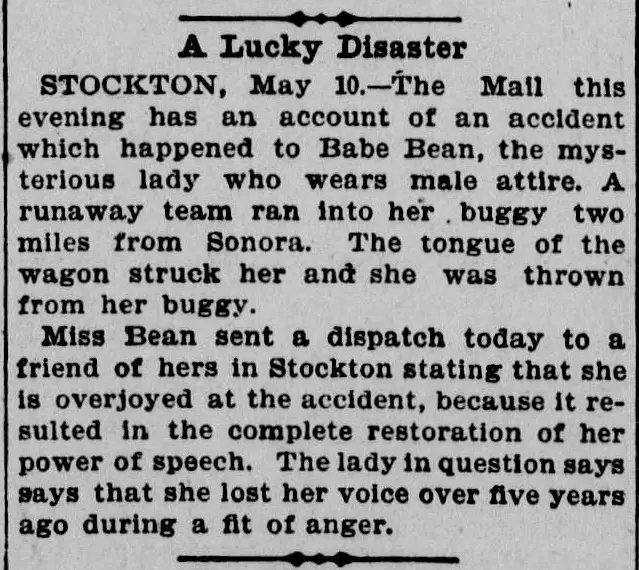
Transcription:
A Lucky Disaster
STOCKTON, May 10. --The Mall this evening has an account of an accident which happened to Babe Bean, the mys-terious lady who wears male attire. A runaway team ran into her buggy two miles from Sonora. The tongue of the wagon struck her and she was thrown from her buggy
Miss Bean sent a dispatch today to a friend of hers in Stockton stating that she is overjoyed at the accident, because it re-sulted in the complete restoration of her power of speech. The lady in question says that she lost her voice over five years ago during a fit of anger.
From The Herald newspaper, May 11th, 1898. Courtesy of the Digital Transgender Archive.

Babe Bean: The Lady Who Wears Male Attire Recovers Her Speech
[This newspaper clipping contains the same content as "A Lucky Disaster", except for some minor punctuation edits.]
From The Herald newspaper, May 11th, 1898. Courtesy of the Digital Transgender Archive.
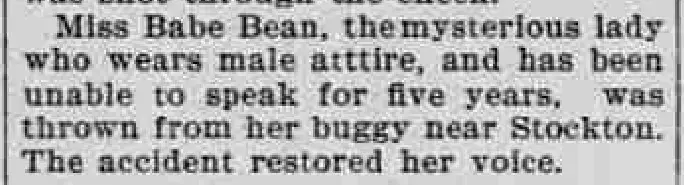
Transcription:
Miss Babe Bean
The Mysterious Lady Who Wears Male Attire
Miss Babe Bean, the mysterious lady who wears male attire, and has been unable to speak for five years, was thrown from her buggy near Stockton. The accident restored her voice.
From The Argus newspaper (Arizona), May 21st, 1898. Courtesy of the Digital Transgender Archive.

Transcription:
BABY BEAN A BONNY BOY
---
Journalistic Adventures a Stowaway on City of Para.
---
In Man's Clothes She Travels From San Francisco En Route to Manilla--Put Ashore in Honolulu.
---
She looked every inch a man when she came ashore in Hono-lulu from the transport City of Para a day or two ago, with a large black slouch hat shading her comely features and matching her close cropped hair, a black cut-away coat and shining patent leathers giving her quiet a stylish appearance and her many car-riage dispelling any suspicion of femininity that might be aroused by her womanly hands and feet.
Bertie Bean, better known as "Babe Bean" is a journalist and believes in getting the news at any price; she wanted to go to Manila as correspondent for certain New York and San Francisco papers, so donned man's apparel and went aboard the City of Para in San Francisco just before the transport sailed for Honolulu.
There were several civilians aboard and Babe Bean's presence was not remarked. She took her mess with the soldiers and slept on deck and spent her time writ-ing.
It was not until a day or two before the Para got into this port that Babe was discovered aboard; then it was her turn to be vacin-ated. She had to undergo that formality with the rest and was consequently exposed much to her confusion.
If it had not been for the vacin-ation, Babe would have had her passage to Manila assured; as it is, however, the lady was put ashore here, where she immdiate-ly set about securing a passage to the Philippines .
San Francisco papers have re-corded some of Miss Bean's form-er exploits in the newspaper line, she will get to Manila if previous adventures are any indication.
Miss Bean was at one time a famous girl detective and has also been connected with the Stockton Mail.
Babe has friends in Honolulu who speak well of her merits as a journalist.
From the Evening Bulletin newspaper (Honolulu & Oahu, Hawaii), October 17th, 1899. Courtesy of the Digital Transgender Archive.
Last updated: January 4th, 2026.

Comments