
E.W. Burnham
Updated: Dec 8, 2025
Head of the Burnham Novelty Company
Born: approx. March 18th, 1840
Died: approx. April 30th, 1918
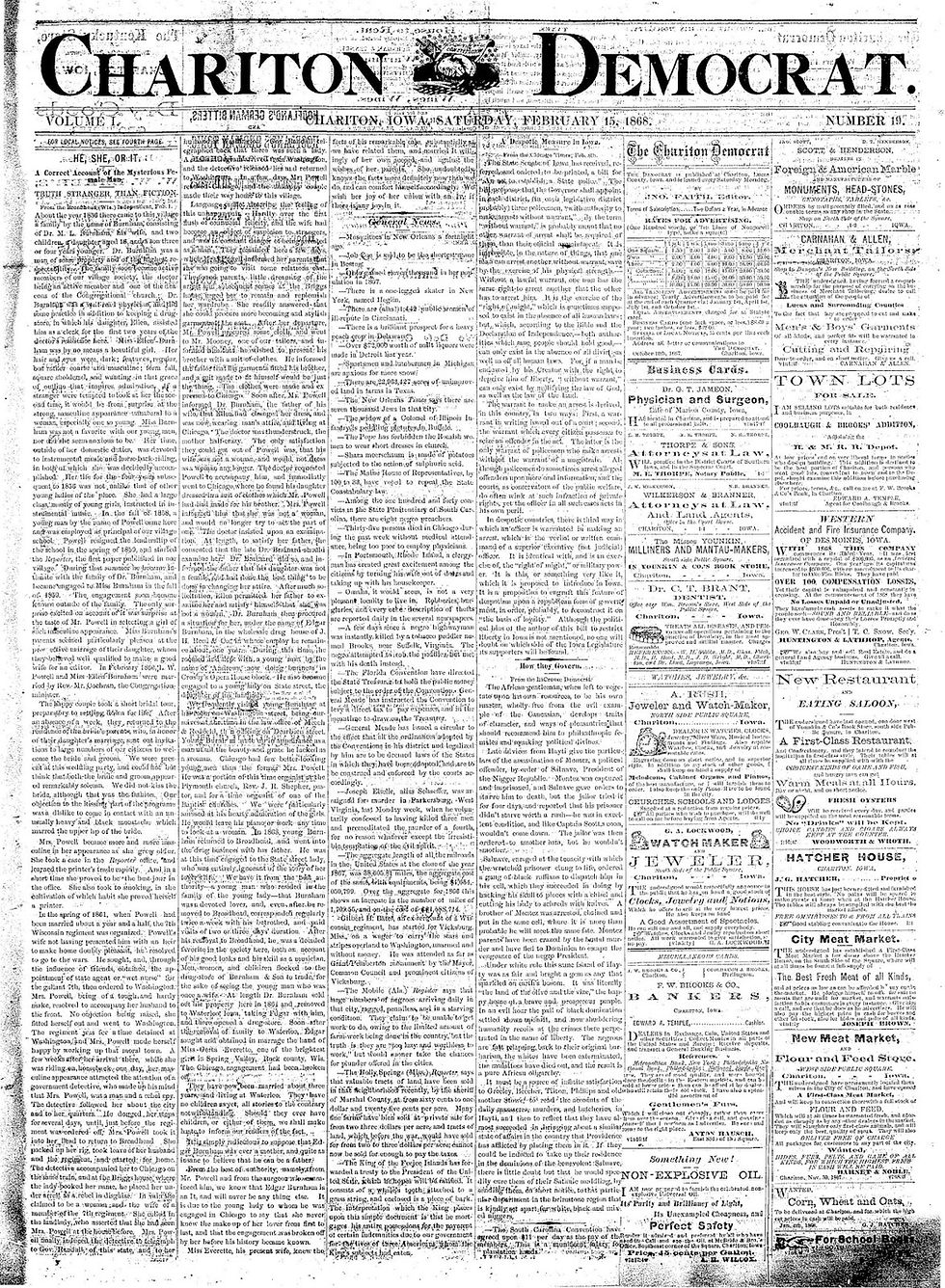
Transcription:
HE, SHE, OR IT
A Correct Account of the Mysterious Female Man
Truth Stranger Than Fiction
About the year 1856 there came to this village a family by the name of Burnham, consisting of Dr. M.L. Burnham, his wife, and two children, a daughter aged 16, and a son three or four years younger. Dr. Burnham was a man of some property and of the highest respectability. The family soon became active members of our village society, the doctor being an active member and one of the deacons of the Congregational church. Dr. Burnham was a well-read physician and did some practice in addition to keeping a drug store, in which his daughter, Ellen, assisted him as a clerk for the first two years of the doctor's residence here.
Miss Ellen Burnham was by no means a beautiful girl. Her hair and eyes were dark; features regular, but rather coarse and masculine; form tall, square shouldered, and wanting in that grace of outline that inspires admiration. If a stranger were tempted to look at her the second time, it would be from surprise at the strong, masculine appearance unnatural to a woman, especially one so young.
Miss Burnham was not a favorite with our young men, nor did she seem anxious to be. Her time, outside of her domestic duties, was devoted to instrumental music and horse-back riding, in both of which she was decidedly accomplished. Her life for the four years subsequent to 1856 were not unlike that of other young ladies of the place. She had a large class, mostly of young girls, instructed in instrumental music.
In the fall of 1858, a young man by the name of Powell came here and was employed as principal of our village school. Powell resigned the leadership of the school in the spring of 1859, and started the Reporter, the first paper published in our village. During that summer he became intimate with the family of Dr. Burnham, and became engaged to Miss Burnham in the fall of 1859. The engagement soon became known outside of the family. The only surprise excited on account of it was surprise at the taste of Mr. Powell in selecting a girl of masculine appearance. Miss Burnham's parents seemed particularly pleased at the prospective marriage of their daughter, whom they believed well qualified to make a good wife for an editor. In February of 1860, L.W. Powell and Miss Ellen Burnham were married by Rev. Mr. Cochran, the Congregational minister.
The happy couple took a short bridal tour, preparatory to settling down for life. After an absence of a week, they returned to the residence of the bride's parents, who, in honor of their daughter's marriage, sent out invitations to large numbers of our citizens to welcome the bride and groom. We were present at this wedding party, and could not but think that both the bride and groom appeared remarkably solemn. We did not kiss the bride, although that was the fashion. Our objection to the kissing part of the programme was a dislike to come in contact with an unusually heavy and black moustache which marred the upper lip of the bride.
Mrs. Powell became more and more masculine in her appearance as she grew older. She took a case in the Reporter office, and learned the printer's trade rapidly. And in a short time she proved to be the best jour in the office. She also took to smoking, in the cultivation of which habit she proved herself a printer.
In the spring of 1861, when Powell had been married about a year and a half, the 7th Wisconsin regiment was organized. Powell's wife not having presented him with an heir to make home doubly pleasant, he resolved to go to the wars. He sought, and, through the influence of friends, obtained, the appointment of state agent or "wet nurse" for the gallant 7th, then ordered to Washington. Mrs. Powell, being of a tough and hardy make, resolved to accompany her husband to the front. No objection being raised, she fitted herself out and went to Washington.
The regiment was for a time detained at Washington, and Mrs. Powell made herself happy by working up that moral town. A few weeks after her arrival there, while she was riding on horseback one day, her masculine appearance attracted the attention of a government detective, who made up his mind that Mrs. Powell was a man and a rebel spy. The detective followed her about the city and to her quarters. He dogged her steps for several days until, just before the regiment was ordered off, Mrs. Powell took it into her head to return to Brodhead.
She had packed up her rig, took leave of her husband and the regiment, and started for home. The detective accompanied her to Chicago on the same train, and at the Briggs house, where the lady booked her name, he placed her under arrest as a rebel in disguise. In vain she claimed to be a woman and the wife of a member of the 7th regiment. She called in the landlady, who asserted that she had seen Mrs. Powell at the house before. Mrs. Powell finally induced the detective to telegraph to Gov. Randall, of this state, and to her husband at Washington. Gov. Randall telegraphed back that there was such a lady. A second telegram arrived from Washington and the detective released her and returned to Washington. In a few days, Mr. Powell reached Chicago, and the unhappy couple made their way home to this village.
Language cannot describe the feelings of this unhappy pair. Hardly over the first flush of connubial felicity, and the wife had become an object of suspicion to strangers, and was in constant danger of being arrested as a man. They remained here a few days, when Mrs. Powell informed her parents that she was going to visit some relations east. The fond parents, little dreaming of the arrest and subsequent scenes at the Briggs house, urged her to remain and replenish her wardrobe. She readily answered that she could procure more becoming and stylish garments in the east.
After her departure, Mr. Powell procured some cloth and went to Mr. Mooney, one of our tailors, and informed him that he wished to present his brother with a suit of clothes. He informed the tailor that his garments fitted his brother, and a suit made to fit himself would be just the thing. The clothes were made and expressed to Chicago.
Mr. Powell informed Dr. Burnham, the father of his wife, that Ellen had changed her dress, and was now wearing man's attire, and living at Chicago. The doctor was thunderstruck, the mother half crazy. The only satisfaction they could get out of Powell was, that his wife was not a woman and would no longer try to act the part of one.
The doctor insisted upon an examination. At length, to satisfy her father, she consented that the late Dr. Brainard should examine her. Dr. Brainard did so, and informed the father that his daughter was not a female and had done the best thing to be done in changing her attire. After much solicitation, Ellen permitted her father to examine her and satisfy himself that she was not a woman.
Dr. Burnham then procured a situation for her, under the name of Edgar Burnham, in the wholesale drug house of J. H. Reed & Co., in whose employ he remained about one year. During this time, he roomed and slept with a young man by the name of Andrews, now doing businiess in Crosby's Opera House block. He also became engaged to a young lady on State street, the daughter of his landlady.
We frequently visited young Burnham at his room on Washington street, being ourselves at the time in the law offices of Meech & Redfield, the office being on Dearborn street. Young Burnham made up in appearance as a man of all the beauty and grace he lacked as a woman. Chicago had few better-looking young men than the former Mrs. Powell. He was a portion of this time organist at the Plymouth church, Rev. J.R. Shepherd, pastor, and for a time organist of one of the Baptist churches. We were particularly amused at his hearty admiration of the girls. He would leave his piano or work any time to look at a woman.
In 1863, young Burnham returned to Brodhead, and went into the drug business with his father. He was at this time engaged to the State street lady, who was entirely ignorant of the story of her lover's life. We have it from the best authority --- a young man who resided in the family of the young lady --- that Burnham was a devoted lover, and, even after he removed to Brodhead, corresponded regularly twice a week with his betrothed, and paid visits of two or three days' duration.
After his removal to Brodhead, he was a decided favorite in the society there, both on account of his good looks and his skill as a musician. Men, women and children flocked to the drug store of Burnham & Son to trade, for the sake of seeing the young man who was once a wife.
At length Dr. Burnham sold out his property here in 1864 and removed to Waterloo, Iowa, taking Edgar with him, and there opened a drug store. Soon after the removal of family to Waterloo, Edgar sought and obtained in marriage the hand of Miss Gerta Everette, one of the brightest girls in Spring Valley, Rock County, Wis. The Chicago engagement had been broken off.
They have now been married about three years and living at Waterloo. They have no children as yet, all stories to the contrary notwithstanding. Should they ever have children, or either of them, we shall make haste to inform our readers of the fact.
It is simply ridiculous to suppose that Edgar Burnham was ever a mother, and quite as insane to believe that he can be a father.
From the best of authority, namely from Mr. Powell and from the surgeon who examined him, we know that Edgar Burnham is a It, and will never be anything else. It is due to the young lady to whom he was engaged in Chicago to say that she never knew the make-up of her lover from first to last, and that the engagement was broken off by her before his history became known.
Miss Everett, his present wife, knew the facts of his remarkable case, substantially as we have related them, and married It willingly of her own accord and against the wishes of her parents. She undoubtedly knows the facts more definitely now than we do and can comfort herself accordingly. We wish her joy of her union with an It if there is any joy in it.

Transcription:
A STRANGE STORY
A VERY STRANGE ONE--THE STORY OF A MAN TRANSFORMED INTO A WOMAN.
E.W. Burnham the name of the Subject of this Strange Transformation, Former-ly a "Charming Young Girl" of Minneapolis.
The Des Moines Register says: "Many will remember the peculiar gentleman who visited this city some months ago with Burnhan's Electric Light Company. A gentleman with long hair, dark eyes, and long eye-lashes, and though effeminate in his facial appearance, was sufficiently masculine to [raise?] a heavy beard and look fairly to the masculine duties, attending the management of a [do-mestic?] company. This gentleman reg-istered as E.W. Burnham at the hotel where he was stopping, and with him was a young lady who was known by the troupe as his wife, a young, girlish looking, fairly good looking and al-truitive person. It will be remember-ed that Prof. Morgan Gibney and wife of this city, were with the company, and in a dramatic way were the life and strength of the company in the little [success?] it achieved. The Pro-fessor and Mrs. Gibney left the com-pany in Illinois several months ago. Now comes a peculiar story from St. Paul, which encompasses Burnham in a pale of [romance?], the like of which one does not often read about, unless the ecstatic Don Juan of [Byron?], which might be considered its near-est double in fiction. The St. Paul Pioneer Press of March 11th says it is a ridiculous and [alward?] story, and yet, perhaps, is worth publishing:"
"The presence in the city of the Burnham Novelty Company recalls one of the most remarkable [histories?] known to many Minneapolis people by reason of one of the other actors in the strange domestic drama having for a period been a resident of that city. A good many people will recall Maj. W.L. Powell, who for a short time, along about 1878, was editor of the Tribune. Prior to this time Powell had led the life of a Bohemian, and in his travels went to Broadbend, Wis., where he met a charming young lady, [possessed?] of talent as a musician. Maj. Powell was then lecturing, and made a favorable impression both up-[?] the young lady and her parents, and the friendship for the girl ripen-ed into love and marriage. The young lady was about 19 years of age, had always been reared delicately by a family of the highest respectability. The father was a physician and drug-ist. Soon after her marriage to Maj. Powell a change began to take place: her complexion became swarthy and a beard began to grow, which demand-ed a received the [?] atten-tion of a razor. Other physical changes went on, and after the couple had been reasonably happily married for a period of nearly three years, de-spite the Major's dissolute habits, it became impossible to deny the fact that the girl was more [?] than woman. A visit was made to Chicago, an [?] physician...[text indecipherable]... The disclosure was extremely mortifying to the parents of the ex-wife, and they shortly after-ward removed to another place. The [?] individual availed himself of his prerogative and put away crinoline[?] and donned male [habits?] and commenced work in a drug story in Chicago under the name of E.W. Burnham, a change in the given name only being made to suit the change in sex. During the period young Burnham had lived as a woman the acquaintance had been focused[?] of another young woman also of musical predilections. The two "girls" were chums, even room-mates together, without suspicion of another condition being present. The regard then formed [ripened?] into love, and after a period had clasped the two women married, and have since lived happily together, [?] their home at Waterloo, Iowa. The husband and wife are none other than E.W. Burn-ham, the head of the Burnham Novel-ty Company, and Mrs. Gertie Everette Burnham, one of the members of the party.
There is nothing in Mr. Burn-ham's appearance to indicate the strange history: and he is now thoroughly masculine in appearance, capa-ble of raising a heavy beard, though to meet the requirements of his busi-ness, he is cleanly shaven. The facts are all authenticated. Mr. Burnham is the nephew of a prominent citizen of Minneapolis is whose family he lived as a charming young girl for a considerable time, and is the subject of one of those freaks of nature which are rare, but undoubtedly occur. He is above the average in talent and ability, and has turned his taste for music in-to the organization which made its apperance at the Pence[?] Opera House last evening.
Burnham takes no part in the per-formance of the company that bears his name other than to preside at the piano. Mrs. Burnham appears in the first part and in the drama with which their rather queer performance is concluded."

Transcription:
A Man and husband has turned up in St. Paul who was once a woman and wife. He, she or it is now known as E.W. Burnham, the head of the Burnham Novelty company. When he, she or it (pronouns get badly mixed in this case) was a blooming girl of nineteen summers and a smooth face, she was married to Major Palmer, formerly editor of the Minneapolis Tribune. After three hap-py years as a wife, a transformation came on. She shed her smoothness and a hirsute covering bearded her face.
She became a man, and as Palmer wanted a woman for his wife, a divorce ensued. Then she, who was now he, not relishing a bachelor's lonely life, married a lovely girl who is now his wife, and one of the members of his company. And so the old classic fable is revived in our neigh-boring city, and we have a he that was a she, and knows all about it.
Wonder if he has any special skill in managing his wife, or if he can dodge with more success than those who were always males, when she wants a new dress or a new hat?
From the Duluth News-Tribune, Mar. 17, 1882. Courtesy of the Digital Transgender Archive.

Transcription:
A Strange Metamorphosis
A remarkable phenomenon is related by the Dubuque(?) Times. Major Powell*, for-merly editor of the Minneapolis Tribune, some ten years ago married an accom-plished young lady in Broadhead, Wis. Soon after the marriage a change in the wife began to take place: her complexion became swarthy and a beard began to grow, which demanded and received the assiduous attention of a razor. Other physical changes went on, and after the couple had been reasonably happily mar-ied for a period of nearly three years, it became impossible to deny the fact that the girl was more man than woman.
A visit was made to Chicago, an eminent physician was consulted, who confirmed the suspicion, and the major and his wife separated, there being no matrimonial pre-vision to bind two males together. The metamorphosized individual availed him-self of his prerogative, put away crinoline and donned male habliments, and com-menced work at a drug store in Chicago under the name of E.W. Burnham a change in the given name only being given to suit the change in sex. During the period young Burnham had lived as a woman, the acquaintance had been formed of another young woman, which acquaint-ance was renewed, and in course of time they were married. This couple are now traveling through the west with a dramatic company known as the Burnham Novelty Company. These facts, says the Dubuque(?) Times, are well authenticated. Mr. Burnham is the nephew of a prominent citizen of Minneapolis, in whose family he lived as a charming young girl for con-siderable time, and is the subject of one of those curious freaks of nature, which are rare, but undoubtedly occur.
From the Dubuque(?) Times, Mar. 28, 1882. Courtesy of the Digital Transgender Archive.
*Burnham's ex-husband appears to have a different name in this second article clipping than in the first (Palmer vs Powell)
Last updated: December 7th, 2025.


Comments